
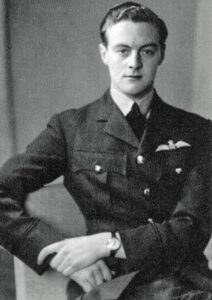
Pilot Officer Rogers Freeman Garland Miller
For those still gathering the harvest from the fields to the west of Cheselbourne, the morning of September 27th 1940 was sunny and dry. The farms in this area would have been a mix of wheat, barley, sheep and dairy cows, much the same as today although fields were smaller in 1940 and the farm cottages were dwellings for the workers rather than holiday lettings. Today, the landscape has altered in as much as the fields are larger, with fewer hedgerows. Farm buildings are now holiday lettings and there are few farm workers. When I visited the scene in September 2022, the cottages are still there and Doles Ash farm house, a C16th listed building probably looks much the same as it did in 1940.
The farm workers, busy with the harvest, were probably unaware of the formations of Luftwaffe bombers and their fighter escorts crossing the English coast near Swanage, heading north towards Britain’s largest aero engine works in Bristol, a prime target. Number Ten Group, RAF was charged with the defence of the West of England and could call upon eight squadrons to engage the enemy. 609 (West Riding) Squadron, motto, “Tally Ho”, was based at Middle Wallop with a forward section at Warmwell. It was a Royal Auxiliary Airforce Squadron originally made up of pilots who had funded their own flying training. Rogers Freeman Garland Miller had started his flying training while at King Edwards School, Stratford upon Avon in 1939. He was a talented pupil, skilled at sports and eagerly followed his elder brother into the RAF. P/O Miller completed his training at Aston Down airfield before eventually being posted to 609 Sqdn in June 1940.
On the morning of September 27th 1940, 609 squadron were scrambled from RAF Warmwell at 11:15. They had already been in action for several days as the Luftwaffe had changed their targets from London and the South East to alternative targets including Bristol. On this occasion, the call to action came late for the young pilots and they didn’t have sufficient time to reach an altitude where they could dive down onto the enemy. P/O Miller led Yellow Section towards a group of Luftwaffe fighters that were already circling above Warmwell airfield. These were the escorting Messerschmitt 110’s of ZG 26, “Horst Wessel”, an elite Luftwaffe unit. When the squadron commanders radio failed, Miller took command and led 609 into action.
At about 11.45 an aerial battle took place above the fields between Cheselbourne and Piddletrenthide, five miles north east of Dorchester. 609’s mk 1 spitfires were taking on the Bf110’s of ZG26 and as the spitfires, outnumbered and at a disadvantage by having to climb towards their enemy, broke into the defensive ring adopted by the Messerschmitts, a brief but dramatic aerial combat took place. This was an engagement between a Spitfire mk 1, serial number X4107 flown by the 20-year-old Pilot Officer RFG Miller and a Messerschmitt Bf110C piloted by Gefreiter Georg Jakstadt with Gefr Emil Liedtke as his air gunner. This was a clash between two of the best squadrons on either side and in the battle that followed, Miller’s comrades, P/O Crooke and P/O Ogilvie witnessed what happened. It seems that Miller led the spitfires in a head on attack on the Messerschmitts and at a closing speed of around 600mph, both pilots pulled up at the same time. Ogilvie, flying astern of Miller, reported a terrific explosion and pieces of both aircraft passing close by his own spitfire. Horrified by what he had witnessed, Ogilvie avoided the debris and turned to see a white parachute emerging from the explosion as Millers aircraft was destroyed. A further parachute was seen coming from the wrecked Me 110.
609 Squadron Operations Record Book records that, “With the Flight Commander’s R/T having failed, Yellow Leader, P/O Miller led the squadron into a head on attack on the escorts seen circling over Warmwell, losing his life in a collision. Miller had already been credited with three kills and two probables having joined the squadron in June 1940”
On paper the spitfire was the superior machine when up against the slower and less manoeuvrable but heavily armed Messerschmitt. But of course, there are other factors to consider and while we know that 609 squadron pilots had a reputation for skill and tenacity and also that P/O Miller had already been Mentioned in Despatches for his combat record, on this occasion his luck ran out.
Witnesses on the ground stated that the two aircraft collided head on somewhere above Kingcombe Farm, to the west of Cheselbourne, with the Spitfire exploding. Miller didn’t stand a chance. With a fuel tank in front of his cockpit and oxygen tanks behind, he probably died in the explosion. The pilot of the Me 110 escaped by breaking the glass of his canopy as his Messerschmitt tumbled earthwards and parachuted to safety where he was captured. His air gunner did not survive, however. The Me110 crashed in fields near Piddlehinton and the remains of the spitfire plummeted to earth near Doles Ash Farm. The German air gunner, Emil Leidtke did not survive the crash and is buried in Brookwood Military Cemetery. The pilot of the Me 110, Georg Jakstadt was able to escape from his wrecked aircraft and parachuted to safety. We know that he was detained, probably by the farmworkers, and taken to Doles Ash Farm where he was given home-made lemonade and cake until the constables from Dorchester Police Station arrived to take him into custody. Jakstadt was detained as a Prisoner of War and interrogated at The Oval Cricket Ground which had become a holding centre for prisoners of war before they were taken to one of the camps in The Lake District. His interrogation report forms part of the evidence of this air action. Jakstadt commented that he was surprised by the kindness shown to him at Doles Ash. He had been briefed to expect a much more hostile response.
In 1940, Hilda Rendall was a three-year-old living with her parents at Doles Ash Farm about three miles west of Cheselbourne. Her father was a shepherd at that time and they lived in one of the farm cottages adjacent to the farm. She recalls that there had been a lot of aircraft in the skies that summer and her father had dug an air raid shelter in the garden. Despite the rationing, she remembers that there was enough to eat with eggs, milk, meat and vegetables always available. The war had not directly affected the family, but the events of September 27th were about to change that.
I interviewed Hilda in August 2020 and she reported to me that the noise of the aircraft overhead had increased in the preceding days. We now know that this was due to a concerted series of Luftwaffe attacks on the Bristol aircraft factories. On that morning she was helping her mother hang out washing in their garden. While they were aware of the noise of aircraft overhead, it all seemed a long way away and so they didn’t take shelter.
The domestic duties were suddenly interrupted by her father shouting for them to take cover. She clearly remembers a screaming noise, rapidly getting louder. There was no time to get to the shelter and her mother flung the little girl to the ground. With a tremendous bang, the remains of Miller’s spitfire crashed into the field nearby. Hilda remembers her mother gathering her up and running back into the house for safety as other pieces of metal rained down. The wreckage of the Messerschmitt 110 that had collided with P/O Millers spitfire also fell to earth not far away. And the sole survivor of the crash, the German pilot soon floated down on his parachute.
We know that the German pilot, Gefreiter Georg Jackstadt was brought to Doles Ash Farm having been apprehended by farm workers. He was later taken into custody by the local police from Dorchester and eventually delivered to the authorities in London.
Pilot Officer Miller’s Spitfire and the remains of the Messerschmitt were covered with tarpaulins before the wreckage was recovered. The body of the German air gunner, Emil Liedtke was later interred at the military cemetery in Brookwood. Pilot Officer Miller’s family were notified the next day by telegram and his body was taken to Radford Semele where he was buried with his brother John who had been killed when his Wellington bomber crashed on landing several weeks previously at RAF Mildenhall.
Miller was posthumously Mentioned in Despatches for “gallant and distinguished service.”
Tragically, Miller’s brother, P/O JG Miller, also a pilot and serving with 149 Squadron, was killed in a landing accident on 12th August 1940 aged 23. His Wellington IC P9244 collided with a radio mast on its approach to Mildenhall following a raid on Gelsenkirchen. We know that RFG Miller was aware of his brother’s death, but we can only surmise on how this affected him. The brothers are buried side by side in St Nicholas’s Church, Redford Semele, Warwickshire.
Rogers Freeman Garland Miller. Born in Redlands, Weymouth 1920
Died September 27th1940
Poet Richard Spender, penned this of his school friend Rogers ;
To RGM
(Fighter-Pilot, killed in action, 1940)
How brilliantly you flew for such short years,
Roger, across the small horizon of my life,
Like laughter, borne on shining wings!
Now you have sped into the Sun,
And stand ennobled in proud robes of flame.
We can no longer see you,
For the light that clothes you is too fine a fire
For our dull, ordinary eyes;
But every day we shall remember you
In the brave glory of the golden sun.
Spender, Parachute Regiment, was killed in Tunisia in 1942, aged 21.
By Robin Maslin – Local Resident